
1Anesthesiologist, CEO and Founder Advanced Pain Management Center Madrid. 2Urogynecologist, CEO and Founder CIMEG MADRID Research Center Madrid
Research Article · Medical & Clinical Research · ISSN: 2577-8005 · Med Clin Res, 2018 · Volume 3, Issue 2
*Corresponding author: Delgado Cidranes E MD, PhD, Anesthesiologist, CEO and Founder Advanced Pain Management Center Madrid, Spin. E-mail: hospitalspain@gmail.com
Submitted: 01 May 2018; Accepted: 10 May 2018; Published: 07 June 2018
Abstract
Introduction: BTL EMSELLA™ utilizes High-Intensity Focused Electromagnetic technology (HIFEM) to cause deep pelvic floor muscles stimulation and restoration of the neuromuscular control. Key effectiveness is based on focused electromagnetic energy, in-depth penetration and stimulation of the entire pelvic floor area. A single BTL EMSELLA™ session brings thousands of supramaximal pelvic floor muscle contractions, which are extremely important in muscle reeducation of incontinent patients.
Objective: Prospective study to evaluate the safety and preliminary effectiveness of the use of BTL EMSELLA magnetic stimulation in urinary incontinence.
Method: Thirty-two patients with light and moderate urinary incontinence were recruited to perform 6 sessions of BTL EMSELLA during three weeks of initial treatment. Follow-up after three months. The patients received sessions lasting 28 minutes, completing the different treatment protocols. Initially the patients underwent a quality of life test before and after treatment, evaluation with advanced ultrasound using elastography to measure the initial tissue's elasticity and be able to compare after treatment, clinical functional evaluation and urodynamic test.
Results: No adverse reactions were observed. All the patients finished the treatment sessions. Two patients reported increased pain after treatment in the first session corresponding to a VAS scale greater than 5 with duration greater than three hours. The treatment was highly satisfactory in 84,4% of the patients. After the first three months the improvement was maintained in 77% of the patients. No muscle injuries were observed. Elastographic changes and improvement of muscle tone were detected by advanced ultrasound (elastography) in 100% of patients.
Conclusions: BTL EMSELLA is safe, well tolerated and effective for the treatment of mild and moderate urinary incontinence. The observed elastographic changes demonstrate the improvement of pelvic floor muscle tone after treatment. A reduction in the symptoms of urinary incontinence was demonstrated.
Recommendations: Continue increasing the number of cases for research and increase the variables that we have decided to incorporate in the next research section such as MRI and pressure calculation.
Introduction
Urinary incontinence (UI) is a health problem that affects the quality of life of patients who suffer from it and the impact is different depending on the severity, the type of UTI and the woman's experience of this problem. The diagnosis and treatment and treatment of UI in women is presented in the form of algorithms with accompanying notes that incorporate existing evidence and assigned a level of evidence (NE) and a grade of recommendation (GR) [1].
The algorithms are divided into two parts: algorithms for the initial treatment and algorithms for specialized treatment referring to diagnostic techniques and treatments that should only be used by specialists with specific training to establish personalized treatment behavior.
According to the National Observatory of Incontinence (ONI) it is estimated that in Spain could be affected by urinary incontinence about six million people [2].
In the studies carried out on women in Spain, although there are regional variations, the estimated average prevalence for women is 24%, increasing to 30-40% in middle-aged women and up to 50% in elderly women [2,3].
Types of Incontinence
- Stress incontinence Supposedly due to urethral hypermobility and / or intrinsic Urethral Dysfunction.
- Mixed incontinence
- Hyperactive bladder with or without Urinary Incontinence supposedly due to detrusor overactivity
Initial Clinical Evaluation
The most important aspect in the diagnosis in the initial clinical evaluation. The most important variables are: Evaluation of the general condition, assessment of urinary symptoms (including voiding diary and validated questionnaires), impact of UI on quality of life, desire of the patient to receive treatment, urinalysis with or without culture, measurement of residual volume (Table 1).
| N 32 | First Visit | |||||
|---|---|---|---|---|---|---|
| +++ | ++ | + | no | % Positive | % Negative | |
| King’s - Health - Questionnaire | ||||||
| Pain | 1 | 4 | 2 | 25 | 21,8 % | 75,2 % |
| Nocturia | 2 | 4 | 3 | 23 | 28,1 % | 71,9 % |
| Infections | 1 | 2 | 1 | 28 | 12,5 % | 87,5 % |
| Urgency | 2 | 5 | 6 | 19 | 40,6 % | 59,4 % |
| Sexual problem | 1 | 1 | 6 | 24 | 25,0 % | 75,0 % |
| Stress incontinence | 2 | 11 | 6 | 13 | 59,3 % | 40,7 % |
| Physical and social limitations | 1 | 9 | 14 | 8 | 75,0 % | 25,0 % |
Degree of affectation: --no, + mild, ++ moderade, +++ server (Cidranes & Estrada 2018 CIMEG MADRID)
Pelvic and Perineal Examination
It is one of the most important parts to define diagnosis and behavior. The advanced examination of pelvic floor should serve to rule out associations to prolapses of pelvic organs. The evaluation of the pelvic floor musculature is essential as well as the evaluation of vulvovaginal disorders due to urigenital atrophy. In complex cases and with recurrent UTI, interdisciplinary evaluation will be useful and necessary [4].
HIFEM Technology (The BLUE CHAIR EMSELLA)
EMSELLA™ utilizes High-Intensity Focused Electromagnetic technology (HIFEM) to cause deep pelvic floor muscles stimulation and restoration of the neuromuscular control. Key effectiveness is based on focused electromagnetic energy, in-depth penetration and stimulation of the entire pelvic floor area. A single BTL EMSELLA™ session brings thousands of supramaximal pelvic floor muscle contractions, which are extremely important in muscle reeducation of incontinent patients [5-7].
Material and Method
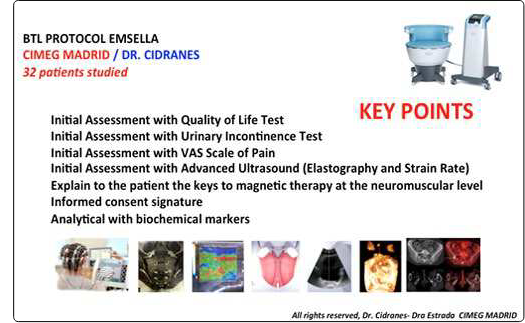
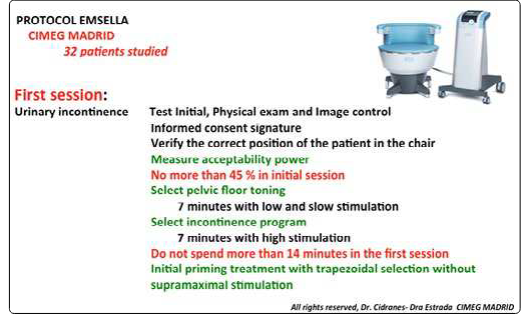
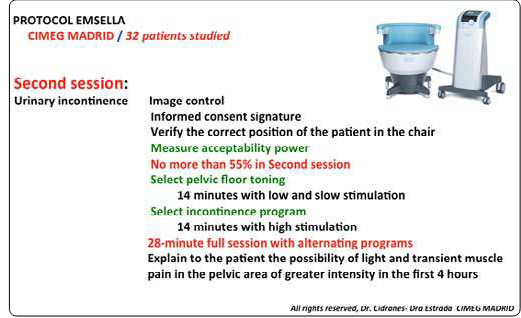
Thirty-two patients with light and moderate urinary incontinence were recruited to perform 6 sessions of BTL EMSELLA during three weeks of initial treatment. Follow-up after three months. (Figure 1) The first session lasted 7 minutes, (Figure 2) the second session 14 minutes to achieve a dose of priming and adequate muscle adjustment assessed in real time by elastography of muscles and fascias. (Figure 3) The patients received four sessions lasting 28 minutes, completing the different treatment protocols. Initially the patients underwent to quality of life test before and after treatment, evaluation with advanced ultrasound using elastography to measure the initial tissue's elasticity and be able to compare after treatment, clinical functional evaluation and urodynamic test.
Text version of this figure
BTL PROTOCOL EMSELLA, CIMEG MADRID / DR. CIDRANES, 32 patients studied. KEY POINTS. Initial Assessment with Quality of Life Test. Initial Assessment with Urinary Incontinence Test. Initial Assessment with VAS Scale of Pain. Initial Assessment with Advanced Ultrasound (Elastography and Strain Rate). Explain to the patient the keys to magnetic therapy at the neuromuscular level. Informed consent signature. Analytical with biochemical markers. A strip of seven small clinical images (a device photo, scans and ultrasound images) runs along the bottom. All rights reserved, Dr. Cidranes- Dra Estrada CIMEG MADRID.
Text version of this figure
PROTOCOL EMSELLA, CIMEG MADRID, 32 patients studied. First session: Urinary incontinence. Test Initial, Physical exam and Image control. Informed consent signature. Verify the correct position of the patient in the chair. Measure acceptability power. No more than 45 % in initial session. Select pelvic floor toning: 7 minutes with low and slow stimulation. Select incontinence program: 7 minutes with high stimulation. Do not spend more than 14 minutes in the first session. Initial priming treatment with trapezoidal selection without supramaximal stimulation. All rights reserved, Dr. Cidranes- Dra Estrada CIMEG MADRID.
Text version of this figure
PROTOCOL EMSELLA, CIMEG MADRID / 32 patients studied. Second session: Urinary incontinence. Image control. Informed consent signature. Verify the correct position of the patient in the chair. Measure acceptability power. No more than 55% in Second session. Select pelvic floor toning: 14 minutes with low and slow stimulation. Select incontinence program: 14 minutes with high stimulation. 28-minute full session with alternating programs. Explain to the patient the possibility of light and transient muscle pain in the pelvic area of greater intensity in the first 4 hours. All rights reserved, Dr. Cidranes- Dra Estrada CIMEG MADRID.
Data Collection
The impact of HIFEM Emsella in our patients has been evaluated through the Spanish version of King's Health Questionnaire 1993 obtaining demographic, subjective, objective variables as well as quality of life. (Table 1) The urinary incontinence questionnaire ICIQ-SF (International Consultation of Incontinence Questionnaire) was carried out. (Table 2) We value in all patients the degree of tissue elasticity through advanced ultrasound and elastography using ESAOTE technology.
| ICISF / n 32 | 0 | 1-3 | 4-6 | 7-10 | Total % Positive |
|---|---|---|---|---|---|
| Frequency of urine loss | 0 | 19 | 11 | 2 | 100 % |
| Amount of urine lost according to patient | 0 | 22 | 8 | 2 | 100 % |
| Escaping urine and affecting daily life | 2 | 19 | 7 | 4 | 93,75 % |
| When do you lose urine? Small activities to big activities | 2 | 10 | 13 | 7 | 93,75 % |
Degree of affectation: 0 no, 1-3 mild, 4-6 moderade, 7-10 server ICIQ-SF Positive greater than 1 (Cidranes & Estrada 2018 CIMEG MADRID)
Results
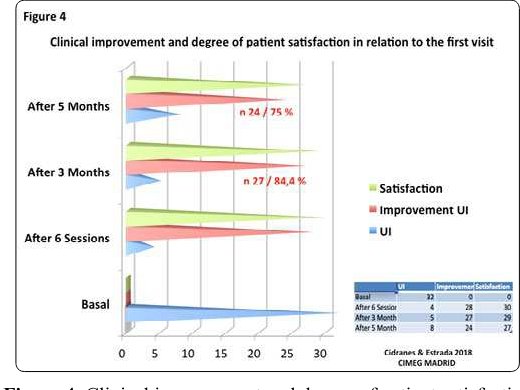
No adverse reactions were observed. All the patients finished the treatment sessions. Two patients reported increased pain after treatment in the first session corresponding to a VAS scale greater than 5 with duration greater than three hours. The degree of improvement after three months was already remarkable and maintained. (Table 3). The treatment was highly satisfactory in 84,4% of the patients. (Figure 4) After the first five months the improvement was maintained in 75% of the patients. No muscle injuries were observed. Elastographic changes and improvement of muscle tone were detected by advanced ultrasound (elastography) in 94 % of patients. (Table 4). After 5 months the degree of satisfaction of patients reaches 84.4% and 75% have solved the problem that generated their urinary incontinence.
| N 32 | After three months | |||||
|---|---|---|---|---|---|---|
| +++ | ++ | + | no | % positive | % Negative | |
| King’s - Health - Questionnaire | ||||||
| Pain | 0 | 2 | 1 | 29 | 09,3 % | 90,7 % |
| Nocturia | 1 | 3 | 1 | 27 | 15,6 % | 84,4 % |
| Infections | 0 | 0 | 0 | 32 | 0,00 % | 100 % |
| Urgency | 1 | 3 | 3 | 26 | 21,8 % | 79,2 % |
| Sexual problem | 0 | 0 | 4 | 28 | 12,5 % | 87,5 % |
| Stress incontinence | 0 | 2 | 2 | 28 | 12,5 % | 87,5 % |
| Physical and social limitations | 0 | 2 | 4 | 28 | 18,7 % | 81,5 % |
Degree of affectation: --no, + mild, ++ moderade, +++ server (Cidranes & Estrada 2018 CIMEG MADRID)
Text version of this figure
Three-dimensional bar chart titled “Clinical improvement and degree of patient satisfaction in relation to the first visit”. Rows, from bottom to top: Basal, After 6 Sessions, After 3 Months, After 5 Months. Three series: UI (blue), Improvement UI (red) and Satisfaction (green). The horizontal axis runs from 0 to 30. Two callouts read “n 27 / 84,4 %” (After 3 Months) and “n 24 / 75 %” (After 5 Months). A small data table at the right of the chart lists values for Basal, After 6 Session, After 3 Month and After 5 Month; its numbers are too small to read reliably in the PDF. Source: Cidranes & Estrada 2018 CIMEG MADRID.
| N 32 | First Visit | After three months | After five months | |||
|---|---|---|---|---|---|---|
| Positive | Negative | Positive | Negative | % Positive | % Negative | |
| Elastography | 30 | 2 | 7 | 25 | 3 / 09,3 % | 29 / 90,6 % |
| Strain Rate | 30 | 2 | 9 | 23 | 7 / 21,8 % | 25 / 78,2 % |
| Urogynecological ultrasound Findings | 14 | 18 | 12 | 16 | 3 / 09,3 % | 29 / 90,6 % |
| MRI | 9 | 23 | 5 | 27 | 2 / 09,3 % | 30 / 93,7 % |
| Uroflowmetry | 17 | 15 | 2 | 30 | 2 / 0,9,3 % | 30 / 93,7 % |
| Urethrocytoscopy | 4 | 28 | 4 | 28 | 4 / 12,5 % | 28 / 87,5 % |
| Clinical Improvement | - | - | 27 84,4 % | 24 75 % | - | |
Positive: Pathological findings, Negative Non Pathological (Cidranes & Estrada 2018 CIMEG MADRID)
Conclusion
BTL EMSELLA is safe, well tolerated and effective for the treatment of mild and moderate urinary incontinence. The observed elastographic changes demonstrate the improvement of pelvic floor muscle tone after treatment. A reduction in the symptoms of urinary incontinence was demonstrated.
Recommendations
Continue increasing the number of cases for research and increase the variables that we have decided to incorporate in the next research section such as Fusion Image and pressure calculation.
References
- Abrams P, Blaivas JG, Stanton SL, Andersen JT (1998) The Standardisation of Terminology of Lower Urinary Tract Function. The International Continence Society Committee on Standartisation of Terminology. Scand d Suppl 114: 5-19
- F Hunskaar S, Burgio K, Diokno AC, Herzog AR, Hjalmas K, et al. (2002) Epidemiology and Natural History of Urinary Incontinence (UI). En: Incontinence 2nd Edition. Abrams P, Cardozo L, ry S, Wein A (Eds). Chp 3, Plymbridge Distributors Ltd., United KingKhoudom 165-202.
- Botlero R, Urquhart DM, Davis SR, Bell RJ (2008) Prevalence and incidence of urinary incontinence in women: review of the literature and investigation of methodological issues. Int J Urol 15: 230-234.
- Almeida FG, Bruschini H, Srougi M (2004) Urodynamic and clinical evaluation of 91 female patients with urinary incontinence treated with perineal magnetic stimulation: 1-year follow-up. J Urol. 2004 Apr; 171: 1571-1574.
- Bickford R, Guidi M, Fortesque P, Swenson M (1987) Magnetic stimulation of human peripheral nerve and brain. Neurosurgery 20: 110-116.
- Bustamante V, de Santa María E, Gorostiza A, Jiménez U, Gáldiz J (2010) Muscle training with repetitive magnetic stimulation of the quadriceps in severe COPD patients. Respiratory Medicine 104: 37-245.
- Berenholz J, Sims T, Botros G (2017) HIFEM Technology Can Improve Quality of Life of Incontinent Patients.
Article information
Copyright: ©2018 : Delgado Cidranes E. This is an open-access article distributed under the terms of the Creative Commons Attribution License, which permits unrestricted use, distribution, and reproduction in any medium, provided the original author and source are credited.