Julene B. Samuels MD, FACS1, Kimberly Evans MD, FACOG2
1Julene B Samuels MD, FACS, Prospect, KY, USA; 2Hillcroft Medical Clinic, Sugar Land, TX, USA
Presented at North American Menopause Society 2020 Virtual Annual Meeting
FEMALE SEXUAL FUNCTION AND URINARY INCONTINENCE AFTER HIFEM® PROCEDURE
HIGHLIGHTS
31 females (49.8±9.9 years), who showed a decreased interest in sexual activity accompanied by UI, were enrolled in this prospective one-arm study.
Subjects’ continence and sexual function have been significantly (P<0.001) improved.
Greatest improvement was seen after 3 months and it was maintained for 6 months.
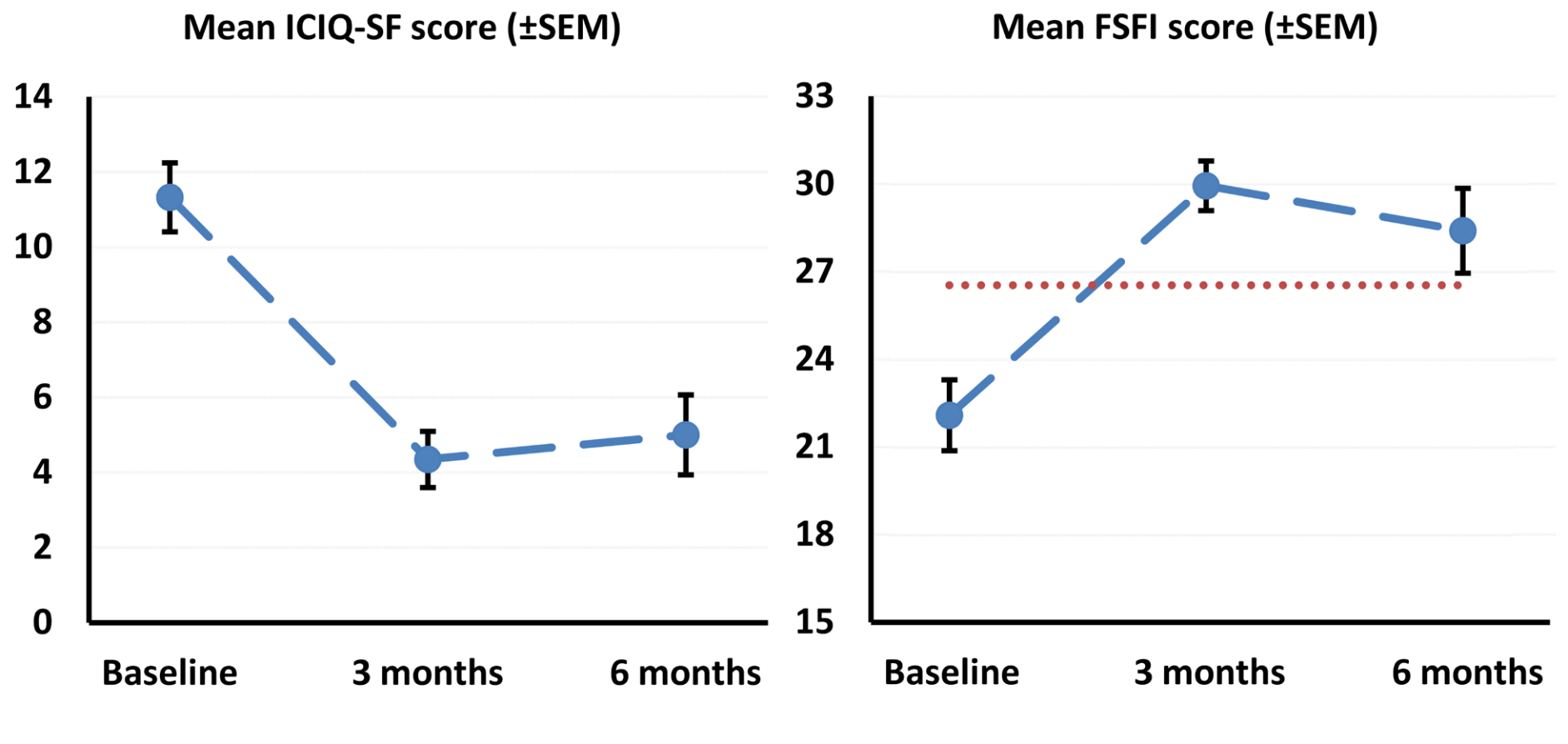
ICIQ-SF overall score decreased on average by 61.6% (-7.0 points)
FSFI showed significant increase by 35.5% (+7.9 points)
PISQ-12 score increased significantly by 26.3% (+8.4 points)
Patients benefited from increased sexual desire, improved lubrication, and arousal, and they were also more satisfied with their orgasm intensity.
ICIQ-SF (left) and FSFI (right) scores were significantly (P<0.001) improved after the HIFEM treatments. Red dotted line indicates the threshold for female sexual dysfunction equal to 26.55 points.Text version of this figure
Two line charts, each plotting a mean score with its standard error (±SEM) at Baseline, 3 months and 6 months. Left, “Mean ICIQ-SF score (±SEM)”, vertical axis from 0 to 14: the score falls from baseline to 3 months and stays low at 6 months. Right, “Mean FSFI score (±SEM)”, vertical axis from 15 to 33: the score rises from baseline to 3 months and stays higher than baseline at 6 months. A red dotted line marks the threshold for female sexual dysfunction, 26.55 points.
This page reproduces the full text of a research paper so that it can be read, searched and shared on our website. The wording, numbers, tables, figures and references are as printed in the PDF, including any typing slips in the original. Running headers and footers, page numbers and line-break artefacts were left out. To make the page easier to navigate and to read with a screen reader, a few labels were added: section headings the PDF did not print (for example “Abstract”), names for tables the PDF left untitled, and a “Text version” under figures that contain words. The original PDF can be downloaded above.
Citation: Samuels JB, Evans K. Female Sexual Function and Urinary Incontinence: Six Month Follow-Up After High-Intensity Focused Electromagnetic Procedure. Presented at North American Menopause Society 2020 Virtual Annual Meeting.
Licence: Not stated in the PDF
Corelife Wellness did not conduct this study, and the words above are the authors’ own. The Libby Chair is our name for BTL Emsella, which uses the HIFEM technology studied in this paper. Browse all 13 studies, or contact the clinic or call 289-608-7136 with any questions.
This page is general information, not medical advice. A health professional can tell you whether this treatment is right for you.
About this study
What did this study conclude?
Subjects’ continence and sexual function have been significantly improved.
Who presented this study, and where can I read the original?
It was presented by Samuels JB, Evans K at North American Menopause Society 2020 Virtual Annual Meeting. The full text is on this page, and the original PDF can be downloaded from it.
What is the Libby Chair?
The Libby Chair is our name for BTL Emsella, which uses a high-intensity focused electromagnetic field (HIFEM) to deliver thousands of supramaximal pelvic floor muscle contractions. It involves no needles, no penetration and no need to undress. Corelife Wellness offers it in Oakville, Ontario.
Powerful pelvic health care by professionals, for you.