
1South Coast Urogynecology, Laguna Beach, California; 2Urology Cabinet ‘Dr. Vasilev’, Sofia, Bulgaria; 3Department of Urology, Aleksandrovska University Hospital, Sofia, Bulgaria
Presented at 38th American Society for Laser Medicine and Surgery Annual Conference on “Energy-based Medicine and Science”, April 11-15, 2018
ABSTRACT
Background: Stress urinary incontinence (SUI) is a prevalent condition among women and negatively affects their quality of life (QoL). The aim of the study was to assess the effect of High-Intensity Focused Electromagnetic (HIFEM) technology in the treatment of SUI.
Study Design/Materials and Method: 30 women from two clinics (United States, Bulgaria) with SUI were delivered a treatment course with HIFEM technology. Patients attended 6 therapies scheduled 2x a week. QoL was assessed through King’s Health Questionnaire (KHQ). Data was collected pre-, post-treatment, at 3- and 6-month follow-up visits. All patients reported the number of used hygienic pads. Scores of questionnaires were calculated and statistically evaluated through t-test (p<0.001). Number of used hygienic pads was calculated as average.
Results: Course of the treatment with the HIFEM technology significantly improved QoL of all women. This was demonstrated as 77% level of improvement in incontinence impact according to the KHQ scores during 6-month follow-up. 95% of patients decreased the use of hygienic pads to 2.0 pads per day and night post-treatment. 71% of patients significantly decreased the use of hygienic pads to 1.33 pad per day and night during 6-month follow-up.
Conclusion: Results suggest that HIFEM technology is an efficacious therapy for treatment of SUI.
1. INTRODUCTION
1.1. Medical background of stress urinary incontinence
Urinary incontinence (UI) is a prevalent condition manifested as involuntary urine leakage and represents a hygienic and a social problem. UI may be classified as stress, urge or mixed type. The stress urinary incontinence (SUI) is usually caused by stress applied over the pelvic floor muscles and bladder, where in the common case this stress is led by coughing, sneezing, laughing or physical activities. In women, the reasons for SUI include events such as condition after childbirth, hormonal changes in menopause, physical inactivity, obesity, aging or pelvic organ prolapse (cystocele, rectocele, uterine prolapse). Further concomitant effects in sexually active women, such as decreased gratification during intercourse and other related dysfunctions, could also be present. In the majority of the cases, patients with SUI, evaluate their QoL as affected in a negative manner due to their condition.
1.2. Current treatment methods for SUI
Therapeutic approaches for SUI depend on the underlying causes of the problem and involve medications, pelvic floor muscles exercising and re-education or surgical interventions.
1.2.1. Drug treatment
The most used drugs for SUI are Alpha-adrenergic agonists, anticholinergic and antispasmodic agents. However, their effectiveness is not always certain and wide range of side effects are present.
1.2.2. Pelvic floor muscles exercising
The Agency for Healthcare Research and Quality suggests rehabilitation techniques such as vaginal weight training or Kegel exercises with a biofeedback. Vaginal weight training involves intravaginal approach pertruding patient’s privacy and comfort. On the other hand, non-invasive Kegel exercises are hard to perform in patients with SUI, because of the decreased level of the pelvic floor muscle awareness and inability to contract these muscles selectively. The conventional muscle strengthening and re-education include intravaginal electrostimulation, which is discomfortable for the patient and risk of tissue burn is still present.
1.2.3. Pelvic floor surgery
The surgical intervention involves procedure that increases urethral outlet resistance – Transobturator Vaginal Tape (TVT). TVT are in the common case carried out only after all other approaches took place.
1.2.4. Behavioral changes
Benefits for improving the condition, to some extent, may be provided by behavior changes such as quitting smoking, avoiding alcohol, losing excess weight, avoiding physical activities (e.g. jumping, running etc.).
As discussed, the SUI condition is prevalent and finding more effective and non-invasive method addressing SUI appears essential for the female intimate health.
2. HIFEM technology
2.1. Mechanism of action
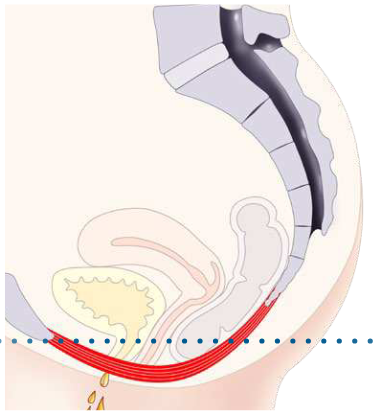
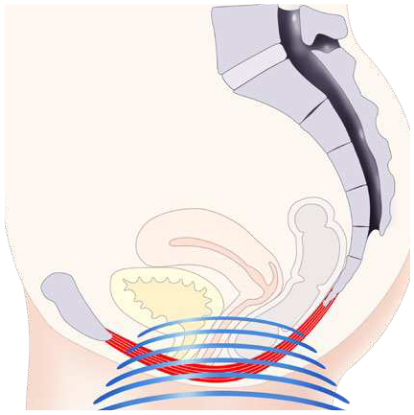
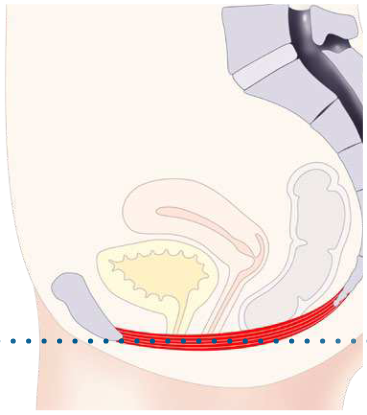
HIFEM technology uses high-intensity focused electromagnetic fields, which are generated by a coil positioned inside a chair applicator. High-intensity focused electromagnetic fields interact and depolarize the pelvic floor motoneurons. Fields deliver focused electromagnetic energy into whole pelvic floor area, which results in selective and supramaximal pelvic floor muscles contractions.
Text version of this figure
Three side-view drawings of the female pelvis, read from left to right and joined by arrows. First, the pelvic floor muscle (red) sags below a dotted reference line, with a downward arrow. Second, blue electromagnetic field lines reach the pelvic floor. Third, the muscle is lifted back up to the dotted line, with an upward arrow.
2.2. Supramaximal pelvic floor muscles contractions
For its myostimulative effect, the method is used in pelvic floor muscles strengthening in order to adress the SUI. The patient affected by the SUI is not able to contract pelvic floor muscles selectively, therefore HIFEM represents targeted pelvic floor muscles strengthening and re-education. As the electromagnetic field passes through human body non-invasively, therapy is delivered to the patients whilst they remain fully clothed throughout the whole therapy.
3. MATERIALS AND METHODS
3.1. Aim
The aim of the study was to assess the effect of HIFEM technology in treatment of SUI.
3.2 Subjects
30 women with SUI (classified as SUI type 0-2a), aged between 38-75 years (Mean±SD= 57.99±10.36) were voluntarily comprised in this study.
3.3. Inclusion and exclusion criteria
Women with diagnosed SUI were the main inclusion criterium. Women with pacemakers, metal implants, blood circulation disorders, tumors, fever, menstruation and pregnant women were excluded from the study.
3.4. BTL EMSELLA™ device
FDA approved device for female urinary incontinence treatment BTL EMSELLA (BTL EMSELLA, BTL Industries Inc.) was used in the course of treatments.
3.5. Used methods
The effect of the course of treatments with the HIFEM technology was assessed through the King’s Health Questionnaire (KHQ). The questionnaire detects the general health condition and incontinence impact in day-to-day life. Additionally, patients were asked to report the number of used hygienic pads.
4. DATA COLLECTION
4.1. Data collection
Data was collected pre- and post-treatment. The long-term effect was evaluated during 3- and 6-month follow-ups.
4.2 Therapy protocol
All patients were delivered the course of treatments consisted of 6 therapies scheduled 2x a week. Patients sat on the BTL EMSELLA chair, feet on the ground, hips, knees and ankles were perpendicularly flexed. Throughout the procedure all patients remain fully clothed. Therapy duration was set to 28 minutes; frequency range between 20-30 Hz with trapezoid intensity modulation were used to achieve gradual motor unit recruitment. Intensity (in %) was set according to patients’ feedback and comfort to trigger supramaximal pelvic floor muscle contractions.
4.3. Statistical evaluation
Data of 30 patients was collected and statistically evaluated.
During the course of treatment no adverse events occured and therapy was well-tolerated by all patients. KHQ scores were calculated through Student’s t-test (p<0.001). Results were compared between pre- and post-treatment, pretreatment and 3- and 6-month follow-ups data. Patients’ reports about the use of hygienic pads were calculated as average pre-, post-treatment, and 3- and 6-month follow-ups.
5. RESULTS
5.1. The KHQ results
The results are discussed in the text below (See Figure 2).
5.1.1. KHQ Part 1 results
Pre-treatment average score of the KHQ-Part 1 was 97.78±34.67 points. Post-treatment average score of the KHQ-Part 1 decreased to 65.83±29.31 points. During 3-month follow-up average score further decreased to 59.72±30.25 points, and to 55.00±35.12 points during 6-month follow-up. These scores are calculated as 28%, 34% and 39% levels of improvement of general health perception (p<0.001).
5.1.2. KHQ Part 2 results
Pre-treatment average score of the KHQ-Part 2 was 284.91±147.08 points. Post-treatment average score of the KHQ-Part 1 decreased to 110.19±115.66 points. During 3-month follow-up the score further decreased to 85.00±119.72 points. During 6-month follow-up the score decreased to 71.02±122.34 points. These scores are calculated as 61%, 70% and 77% levels of improvement of decreased negative incontinence impact (p<0.001).
| Parameter | KHQ Part 1 | KHQ part 2 |
|---|---|---|
| Score pre-treatment (Mean±SD) | 97.78±34.67 | 284.91±147.08 |
| Score post-treatment (Mean±SD) | 65.83±29.31 | 110.19±115.66 |
| Score 3-month follow-up (Mean±SD) | 59.72±30.25 | 85.00±119.72 |
| Score 6-month follow-up (Mean±SD) | 55.00±35.12 | 71.02±122.34 |
| Level of improvement pre- and post-treatment (%) | 28% | 61% |
| Level of improvement pre-treatment and 3-month follow-up (%) | 34% | 70% |
| Level of improvement pre-treatment and 6-month follow-up (%) | 39% | 77% |
Legend: SD = standard deviation; KHQ = King’s Health Questionnaire
5.2. Hygienic pads results
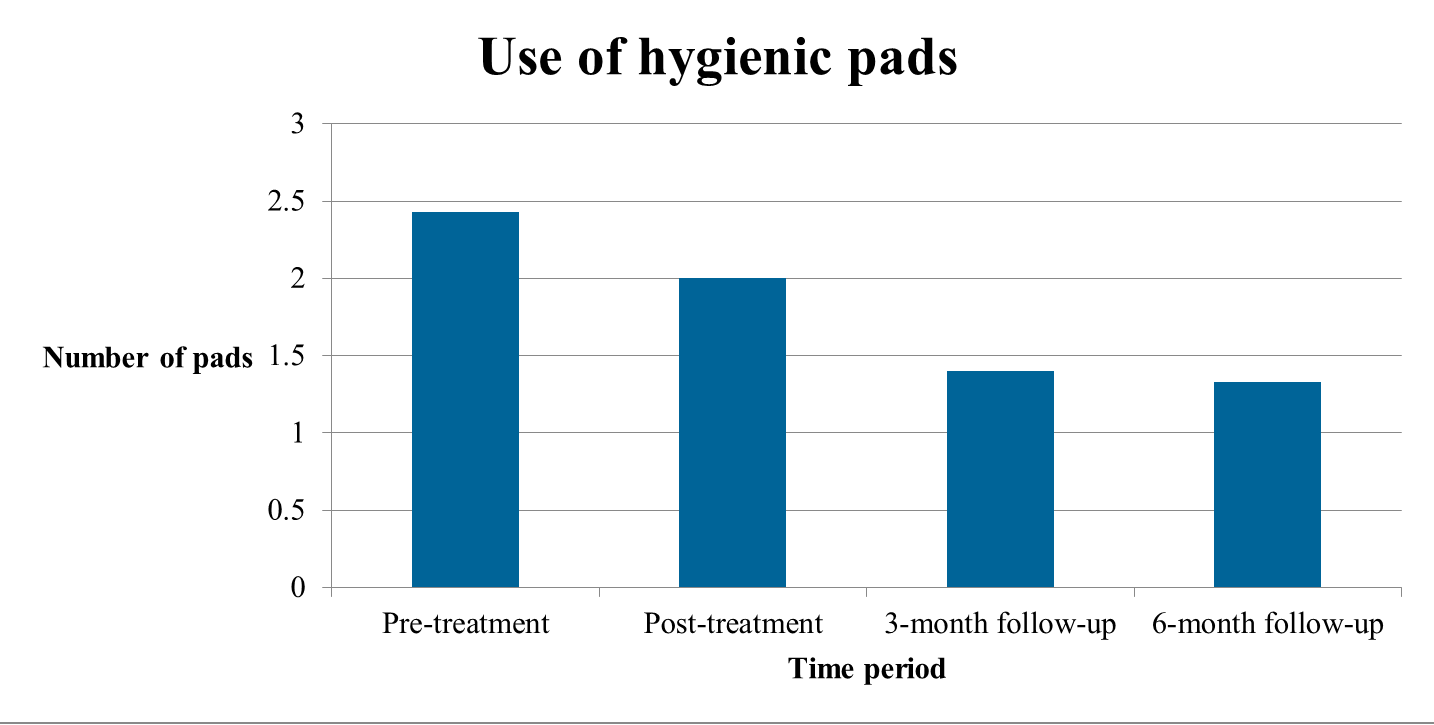
Pre-treatment, patients used on average 2.43 hygienic pads per day and night. Post-treatment, all patients decreased the use to 2 pads per day and night. All patients completed 3- and 6-month follow-up. During 3-month follow-up patients used 1.4 pad per day and night. During 6-month follow-up patients used 1.33 pad per day and night (See Figure 3).
Text version of this figure
Bar chart titled “Use of hygienic pads”. Vertical axis: Number of pads, from 0 to 3. Horizontal axis: Time period, with one bar each for Pre-treatment, Post-treatment, 3-month follow-up and 6-month follow-up.
6. DISCUSSION
Prior to undergoing the treatment, the majority of patients described, according to the answers in the KHQ, that their overall health condition is affected and role, social and emotional limitations are present, which signifies affected QoL. Improvement in patients’ QoL was observed in short- and long-term period according to the results of KHQ and decreased use of hygienic pads. Evidence for effectiveness of this method in addressing SUI is available from previous research. These results are explained through intense stimulative effect of the entire pelvic floor area by using high-intensity focused electromagnetic fields.
7. CONCLUSION
The results obtained from this study suggest the HIFEM technology is promising approach for pelvic floor muscles stimulation that further improves the quality of life among SUI patients.
8. CONFLICT OF INTEREST
Authors declare that no conflict of interest exists.
9. REFERENCES
- Cervigni M, Gambacciani M, a Department of Women’s Health and New Life, Catholic University, Rome, Italy
- National Institute of Diabetes and Digestive and Kidney Diseases. Available from: https://www.niddk.nih.gov/health-information/health-topics/urologic-disease/urinary-incontinence-women/Pages/facts.aspx 1
- Erdem N, Chu FM. Management of overactive bladder and urge urinary incontinence in the elderly patient. Am J Med. 2006 Mar. 119(3 Suppl 1):29-36.
- Abrams PH, Blaivis JG, Stanton SL, Anderson JT. Standardization of terminology of the lower urinary tract function. Neurourol Urodyn. 1988;7:403–427
- Cummings JM, Rodning CB. Urinary stress incontinence among obese women: review of pathophysiology therapy. Int Urogynecol J Pelvic Floor Dysfunct. 2000. 11(1):41-4.
- Sustersic O, Kralj B. The influence of obesity, constitution and physical work on the phenomenon of urinary incontinence in women. Int Urogynecol J Pelvic Floor Dysfunct. 1998. 9(3):140-4.
- Patel AK, Chapple CR. Urodynamics in the management of female stress incontinence--which test and when?. Curr Opin Urol. 2008 Jul. 18(4):359-64.
- Wilson MM. Urinary incontinence: selected current concepts. Med Clin North Am. 2006 Sep. 90(5):825-36.
- Chutka DS, Fleming KC, Evans MP, Evans JM, Andrews KL. Urinary incontinence in the elderly population. Mayo Clin Proc. 1996 Jan. 71(1):93-101.
- Nazir T, Khan Z, Barber HR. Urinary incontinence. Clin Obstet Gynecol. 1996 Dec. 39(4):906-11.
- Howard D, Delancey JO, Tunn R, Ashton-Miller JA. Racial differences in the structure and function of the stress urinary continence mechanism. Obstet Gynecol. 2000 May. 95(5):713-7.
- Linde JM, Nijman RJ, Trzpis M, Broens PM. Urinary incontinence in the Netherlands: Prevalence and associated risk factors in adults. Neurourol Urodyn. 2016 Oct 4.
- Chaikin DC, Groutz A, Blaivas JG. Predicting the need for anti-incontinence surgery in continent women undergoing repair of severe urogenital prolapse. J Urol. 2000 Feb. 163(2):531-4.
- Gibbs CF, Johnson TM 2nd, Ouslander JG. Office management of geriatric urinary incontinence. Am J Med. 2007 Mar. 120(3):211-20.
- Rogers RG. Clinical practice. Urinary stress incontinence in women. N Engl J Med. 2008 Mar 6. 358(10):1029-36.
- American College of Obstetricians and Gynecologists. Practice Bulletin No. 155: Urinary Incontinence in Women. Obstet Gynecol. 2016 May. 127 (5):e66-81.
- DeLancey JOL. Stress urinary incontinence: where are we now, where should we go? Am J Obste Gynecol. 1996;175:311-19.
- Handa VL, Harris TA, Ostergard DR. Protecting the pelvic floor: obstetric management to prevent incontinence and pelvic organ prolapse. Obstet Gynecol. 1996;88:470-78.
- U.S. National Library of Medicine. Available from: https://medlineplus.gov/ency/article/000891.htm
- Roth, E. Medically Reviewed by Graham Rogers, MD. Stress Incontinence. Available from: http://www.healthline.com/health/stress-incontinence#Overview1
- Serati M, Braga A, Cattoni E et al. Transobturator vaginal tape for the treatment of stress urinary incontinence in elderly women without concomitant pelvic organ prolapse: is it effective and safe?. Eur J Obstet Gynecol Reprod Biol. 2013 Jan. 166(1):107-10.
- Hay-Smith, EJC; Dumoulin, C, Pelvic floor muscle training versus no treatment, or inactive control treatments, for urinary incontinence in women (Cochrane Review). Review Group: Cochrane Incontinence Group; Cochrane Database of Systematic Reviews; Substantively amended: 15 November 2005;
- American Physical Therapy Association (APTA), Available from: http://www.womenshealthapta.org/wp-content/uploads/2013/12/pelvicfloordysfunctionfaq-10-19-11.pdf
- Peter K. Sand, MD, David A. Richardson, MD, David R. Staskin, MD, et al. Pelvic floor electrical stimulation in the treatment of genuine stress incontinence: A multicenter, placebo-controlled trial. American Journal of Obstetrics and Gynecology Volume 173, Issue 1, July 1995, Pages 72-79
- Tomonori Y, Kosaku Y, Ryuuji S, Takamichi H, Haruo I, Shino M. Pelvic Floor Electrical Stimulation In The Treatment Of Stress Incontinence: An Investigational Study And A Placebo Controlled Double-Blind Trial, The Journal of Urology, Volume 158, Issue 6, 1997 Dec, Pp 2127–2131
- Wang A, Wang Y, Chen M. Single-blind, randomized trial of pelvic floor muscle training, biofeedback-assisted pelvic floor muscle training, and electrical stimulation in the management of overactive bladder. Urology. Volume 63, Issue 1. 2004 Jan. pp 61-66
- Rodrigo A. Castro, Raquel M. Arruda, Miriam R. D. Zanetti et al. Urogynecology and Vaginal Surgery Section of the Department of Gynecology, Universidade Federal de São Paulo – São Paulo/SP, Brazil. Single-blind, randomized, controlled trial of pelvic floor muscle training, electrical stimulation, vaginal cones, and no active treatment in the management of stress urinary incontinence. Clinics vol.63 no.4 São Paulo 2008
- Hebbar S, Pandey H, Chawla A. Understanding King’s Health Questionnaire (KHQ) in assessment of female urinary incontinence. Int J Res Med Sci 2015;3:531-8.
- Espuña Pons M, Castro Díaz D, Carbonell C, Dilla T. Comparison between the “ICIQ-UI Short Form” Questionnaire and the “King’s Health Questionnaire” as assessment tools of urinary incontinence among women. Actas Urol Esp. 2007;31(5):502–510. doi: 10.1016/S0210-4806(07)73674-4.