
1The Female Pelvic Health Center, Newtown, PA, USA
Abstract accepted for oral presentation at ASLMS 2020
HIFEM® PROCEDURE AND PELVIC FLOOR EXERCISE FOR URINARY INCONTINENCE
HIGHLIGHTS
- Initial short-term data demonstrated that patients might benefit either from HIFEM or pelvic floor muscle training (PFMT) procedures for urinary incontinence (UI).
- Preliminary evaluation suggests higher level of improvement after HIFEM procedure.
- HIFEM procedure resulted in considerable reduction of incontinence pads usage.
- Subjects reported positive changes in their quality of life resulting from reduction of UI symptoms and regained control over the PFM muscles.
- HIFEM procedure was found to be more comfortable.
DESIGN AND METHODOLOGY
- Fifteen subjects with various UI symptoms were recruited and randomly divided into the HIFEM (N=8, 57.4±5.9 years) and PFMT (N=7, 51.9±12.7 years) groups.
- All subjects completed six HIFEM treatments or PFMT sessions performed twice a week for three weeks.
- The same evaluation methodology was used in both groups in regards to comparison of achieved results.
- Subject’s evaluation included various methods: UDI-6, ICIQ-LUTSqol, 3-day ICIQ-BD, Pad Usage, maximal voluntary contraction measurement using biofeedback and digital palpation, therapy comfort and subject satisfaction questionnaire.
- Safety of the HIFEM procedure and pelvic floor exercise was documented.
| Group | Baseline (N) | After 6th (N) | 1-month FU (N) | 3-month FU (N) |
|---|---|---|---|---|
| HIFEM | 8 | 6 | 6 | 5 |
| PFMT | 7 | 8 | 4 | 3 |
RESULTS
- Assessment of pelvic floor contractions revealed muscle strength enhancement in both groups which led to improvement of subjects’ continence.
- The HIFEM procedure tended to have a higher impact on subjects by the means of objective and subjective examination.
- The 3-day bladder diary in HIFEM group revealed considerable decrease of pad usage by -1.2 pads/24 hours, reported at 3 months.
- At 3-month follow-up, the average bladder sensation decreased by 38.9% (-0.82 points on 0-4 scale) after HIFEM procedure while PFMT group score returned to its baseline values.
- UDI-6 and ICIQ-LUTSqol questionnaires in both groups indicated clinically significant improvement of subject’s quality of life after the treatment and at both completed followups.
- Subjects found the HIFEM procedure to be more comfortable then exercise.
- Both treatment modalities showed to be safe, as no adverse events were observed.
- More data with longer follow-up is needed to corroborate the interim results.
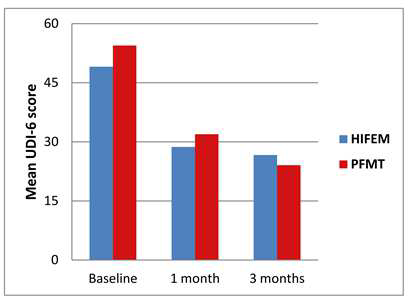
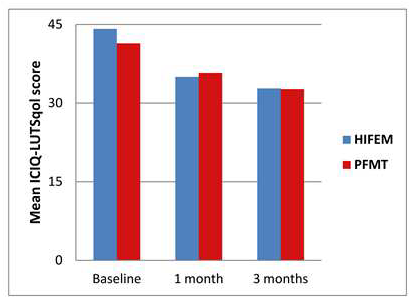
Text version of this figure
Two bar charts comparing the HIFEM group (blue bars) with the PFMT group (red bars) at Baseline, 1 month and 3 months. The first chart shows the mean UDI-6 score (vertical axis from 0 to 60); the second shows the mean ICIQ-LUTSqol score (vertical axis from 0 to 45). In both charts the scores are lower at 1 month than at baseline, and lower again at 3 months.